
2026
Top 10 Trends in
Waste Management
Data-driven accountability, smarter technology, and a decisive shift toward treating waste as a resource.
The top 10 Global Waste Management Trends in 2026 revolve around data-driven accountability, technology-enabled efficiency, and a decisive push toward treating waste as a resource rather than a liability.
1. AI, Robotics and Smart Waste Operations
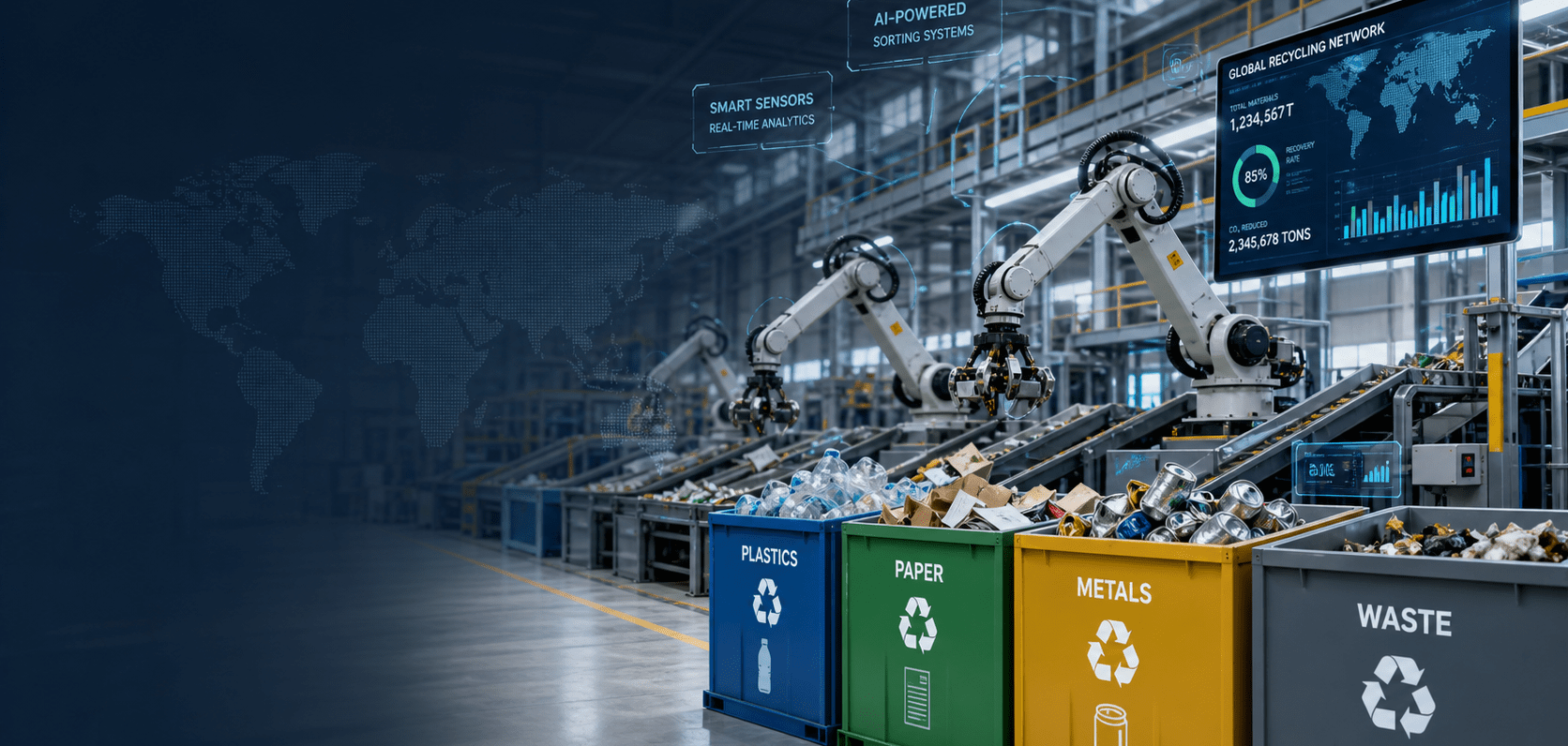
AI and automation have moved from pilots to mainstream in leading waste systems. Vision-based AI is increasingly used to identify materials on sorting lines, reduce contamination, and flag hazardous items such as batteries in real time. Robotic arms now complement human pickers in high-throughput facilities, improving consistency and safety while helping operators cope with labour constraints.
2. Mandatory Digital Waste Tracking and Data Transparency
Digital traceability is becoming a regulatory expectation rather than a voluntary upgrade. Governments are rolling out national or regional digital waste tracking platforms that require real-time or near real-time reporting of waste movements from producers to final treatment. Spreadsheets and paper manifests are being replaced by integrated systems that connect hauliers, brokers, and treatment facilities into a single data chain.
3. Extended Producer Responsibility Expansion
EPR schemes are spreading geographically and deepening in scope. More jurisdictions are implementing EPR for packaging, electronics, and other product categories, shifting financial responsibility for collection and recycling onto producers. Fee structures increasingly reflect recyclability, material type, and design complexity, incentivizing simpler, more recyclable packaging and longer-lived products.
4. Waste as Resource and Urban Mining
Waste is increasingly seen as a source of valuable materials, not simply something to discard. Construction and demolition waste is being treated as a mineable stock of steel, aggregates, and other materials, supported by material passports for buildings. Metals, plastics, and critical minerals from end-of-life products are being recovered and reintegrated into manufacturing as domestic resource streams.
5. Food Waste Reduction and Upcycling
Food waste is a prominent target due to its climate, social, and economic impacts. Regulations and voluntary commitments push retailers, hospitality, and food manufacturers to measure and reduce food waste across their operations. Upcycling is gaining traction as an innovation and branding opportunity by converting surplus or by-products into new products, feed, or materials.
6. Simpler Recycling and Standardized Collection Systems
Many regions are moving toward clearer, more standardized recycling requirements. Simpler recycling reforms aim to harmonize what materials must be separately collected from households and businesses, reducing confusion and contamination. Business obligations to separately collect dry recyclables, food waste, and general waste are rising across multiple markets.
7. Climate, Plastics, and Chemical Risk Integration
Waste, climate and chemical risk are converging in regulation and investor scrutiny. Plastics and other waste streams are being evaluated not only for litter and pollution but also for their lifecycle greenhouse gas emissions and chemical exposure risks. Hazardous substances face tighter rules on disposal and treatment, raising compliance complexity.
8. Digital Compliance, ESG Reporting and Assurance
Waste metrics have become a central part of corporate disclosures. Companies subject to sustainability reporting standards increasingly include detailed waste and circularity metrics with clearer definitions, baselines, and targets. External assurance providers expect auditable waste data and documented data flows from source to report.
9. Decentralized and Community-Based Waste Solutions
Alongside centralization, localized innovation is growing. Community composting, decentralized sorting hubs, and city-level upcycling ecosystems are being deployed, especially where centralized infrastructure is weaker. Social enterprises and start-ups are also experimenting with micro-collection and local repair and reuse platforms.
10. Market Consolidation, Geopolitics and Infrastructure Investment
Waste management markets are being reshaped by macro forces. Mergers and acquisitions are creating larger integrated players that can invest in advanced technologies and cross-border operations. At the same time, geopolitical tensions and supply chain disruptions are encouraging countries to build domestic recycling and recovery capacity.
Opposing Views
One view is that technology, digital tracking, and stronger regulation are essential because global waste systems have historically suffered from weak transparency, fragmented data, and poor enforcement. Advocates argue that more rigorous reporting and AI-enabled oversight create the visibility needed to improve compliance and accelerate circularity.
A competing view is that heavy reporting obligations and rapid digitization can increase administrative burden, especially for smaller firms and regions with less mature infrastructure. Critics argue that a compliance-first approach can crowd out practical local innovation and shift focus away from basic reduction, reuse, and simpler material choices.
How PAD US Can Help
PAD US can help executive teams turn these trends into practical strategy by assessing current waste data maturity, identifying where digital traceability creates the most value, and aligning operational improvements with ESG and compliance priorities. For organizations operating across markets, PAD US can also support governance design, reporting frameworks, technology adoption, and waste-to-value strategies that strengthen resilience and measurable business performance.
Bibliography
- PAD US, “Waste Management Solutions for a Cleaner Future – PAD US Waste Divisions.” https://pad-us.com/wm-divisions/
- PAD US, “PAD US Services: Energy, Waste‑to‑Energy & Biosecurity Solutions.” https://pad-us.com/energy-and-biosecurity-services/
- PAD US, “PAD US Waste and Renewable Energy Divisions.” https://pad-us.com/pad-us_waste_and_renewable_energy_divisions/
- PAD US, “Markets We Serve: Medical, Urban, Naval, Military & Oil & Gas.” https://pad-us.com/pad-us_waste_treatment_solutions_markets/
- Don’t Waste Group, “Waste Management Trends 2026: How Leading Businesses Operate Differently This Year.” https://dontwastegroup.com/waste-management-trends-2026/
- Reworld Waste, “10 Trends Shaping the Future of Sustainable Waste Management.” https://www.reworldwaste.com/news-and-resources/blog/trends-shaping-the-future-of-sustainable-waste-management
- The Access Group, “The Future of Waste Management: Trends & Technology.” https://www.theaccessgroup.com/en-gb/waste-management/the-future-of-waste-management/
- International Finance Corporation (IFC), “Practical Guidance for Digitalizing Waste Management.” https://www.ifc.org/en/insights-reports/2026/practical-guidance-for-digitalizing-waste-management
- Octopus SaaS, “5 Key Waste Management Technologies for 2026.” https://www.octopussaas.com/post/key-waste-management-technologies
- AMCS Group, “Smarter Waste Management: How AI Is Reshaping Waste Collections.” https://www.amcsgroup.com/resources/blogs/smarter-waste-management-how-ai-is-reshaping-waste-collections/
- Vivatech, “How AI Is Improving Waste Management.” https://vivatech.com/news/how-ai-is-improving-waste-management
- Effectual Services, “How AI Can Change Waste Management.” https://www.effectualservices.com/article/how-ai-can-change-waste-management
- World Future Energy Summit, “Circular Economy Gears up for Greater Adoption Enabled by Innovation.” https://www.worldfutureenergysummit.com/en-gb/future-insights-blog/blogs/circular-economy-gears-up-for-greater-adoption-enabled-innovation
- European Commission, “Circular Economy – Environment.” https://environment.ec.europa.eu/strategy/circular-economy_en
- Waste Industry 2026 (Teimas), “Waste Industry 2026: Forecasting Key Trends” . https://www.youtube.com/watch?v=jh2y6182_cM